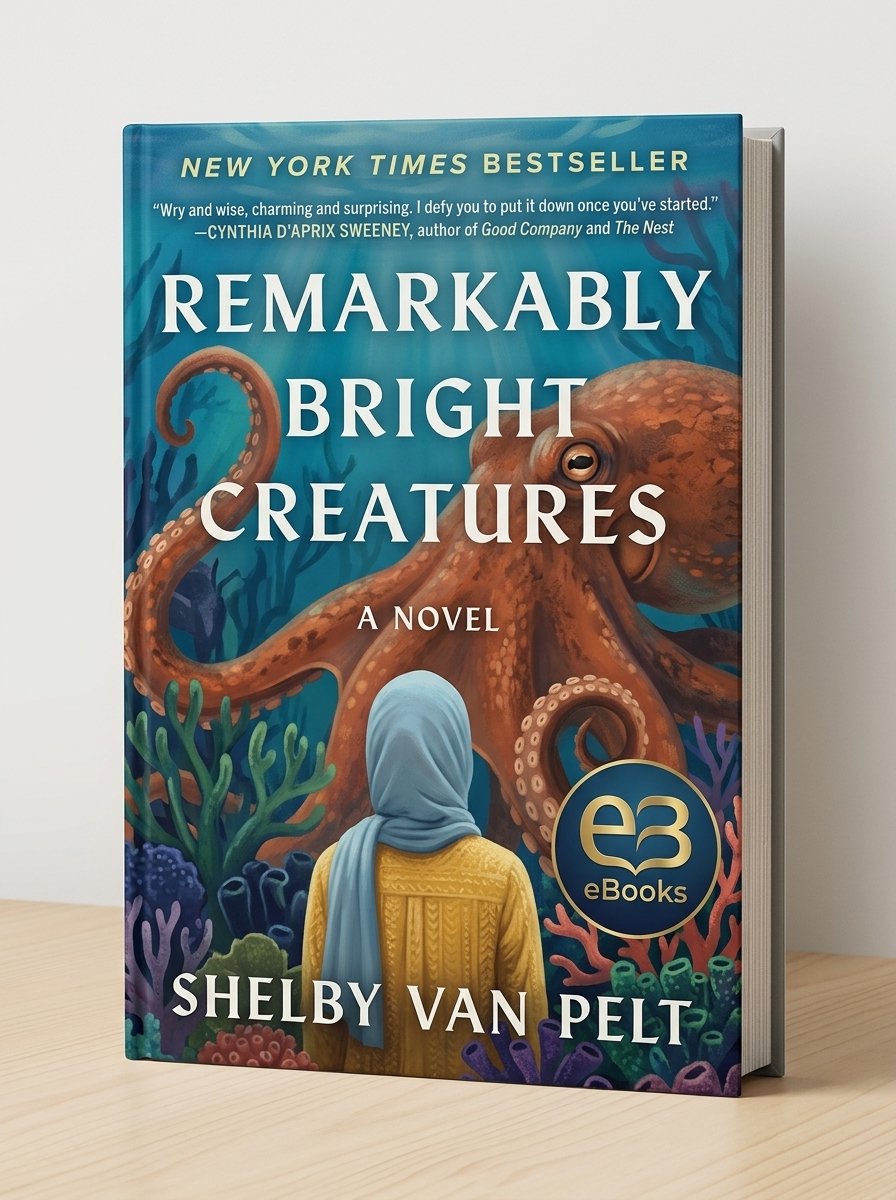
Remarkably Bright Creatures by Shelby Van Pelt is a debut novel following Tova, a widowed aquarium cleaner, and Marcellus, a giant Pacific octopus who observes human secrets from his tank. Alternating between Tova’s grief and Marcellus’s witty narration, the story unravels a decades-old mystery involving a missing son, an abandoned teenager, and unexpected redemption. This article explores five themes illuminated by the novel’s unlikely heroes.
H2: Marcellus the Octopus as Unreliable Narrator
Remarkably Bright Creatures gifts its most intelligent voice to an octopus. Marcellus understands human language, escapes his tank at night, and pieces together clues that Tova misses. Yet his narration is filtered through a non-human consciousness—he values patterns over emotions, captivity over freedom. This unreliability becomes the novel’s engine: readers trust Marcellus’s facts but must interpret their weight. His eventual decision to reveal a secret (or not) redefines what loyalty means when the teller isn’t human.
H2: Tova’s Grief and Daily Rituals
Seventy-year-old Tova has spent three decades scrubbing algae while carrying the disappearance of her teenage son, Erik. The aquarium’s rhythmic labor—mopping, feeding, polishing glass—mirrors her emotional stasis. Remarkably Bright Creatures shows grief not as a crisis but as a slow erosion repurposed into routine. When Marcellus nudges her toward old case files, Tova’s resistance isn’t fear but habit. The novel argues that healing begins not with catharsis but with one small break in an automated day.
H2: Found Family Across Species and Generations
The novel assembles a family from leftovers: Tova (isolated widow), Cameron (a twenty-something dropout searching for his father), and Marcellus (captive genius). None share biology or even language. Yet Remarkably Bright Creatures uses the aquarium as neutral ground where silent understanding replaces dialogue. Cameron’s job scrubbing tanks—taught by Tova—parallels her own decades of service. Marcellus observes both, then engineers their meeting. The book proposes that family is a verb: someone who cleans up your messes, literally and metaphorically.
H2: The Missing Son Mystery Structure
Erik vanished in 1985 under ambiguous circumstances. The novel withholds the truth until the final quarter, feeding readers through Marcellus’s discoveries (a high school yearbook, a locker key, a witness’s guilt). Unlike thrillers, Remarkably Bright Creatures prioritizes emotional closure over plot shock. When the answer arrives, it is quietly devastating: no foul play, only teenage fear and a river. The resolution forces Tova to forgive not a villain but time itself. The mystery exists to deepen character, not to surprise.
H2: Animal Intelligence as Philosophical Mirror
Marcellus’s captivity forces uncomfortable questions. He solves puzzles faster than humans, remembers every visitor, yet cannot open his tank from the outside. Remarkably Bright Creatures uses his intelligence to reflect human limitations: we keep brilliant creatures in small boxes, just as we trap ourselves in grief, shame, or dead-end jobs. When Marcellus chooses to help Tova despite no personal gain, his altruism outpaces most human characters. The novel’s final image—an empty tank—asks readers what remarkable creatures we might become if we stopped confining each other.